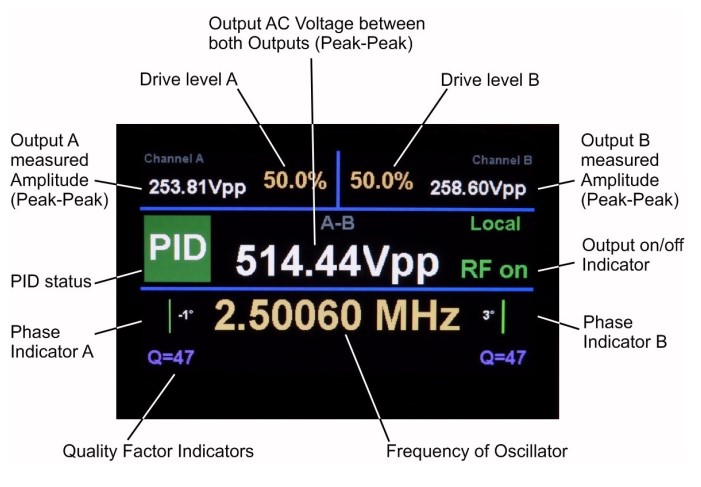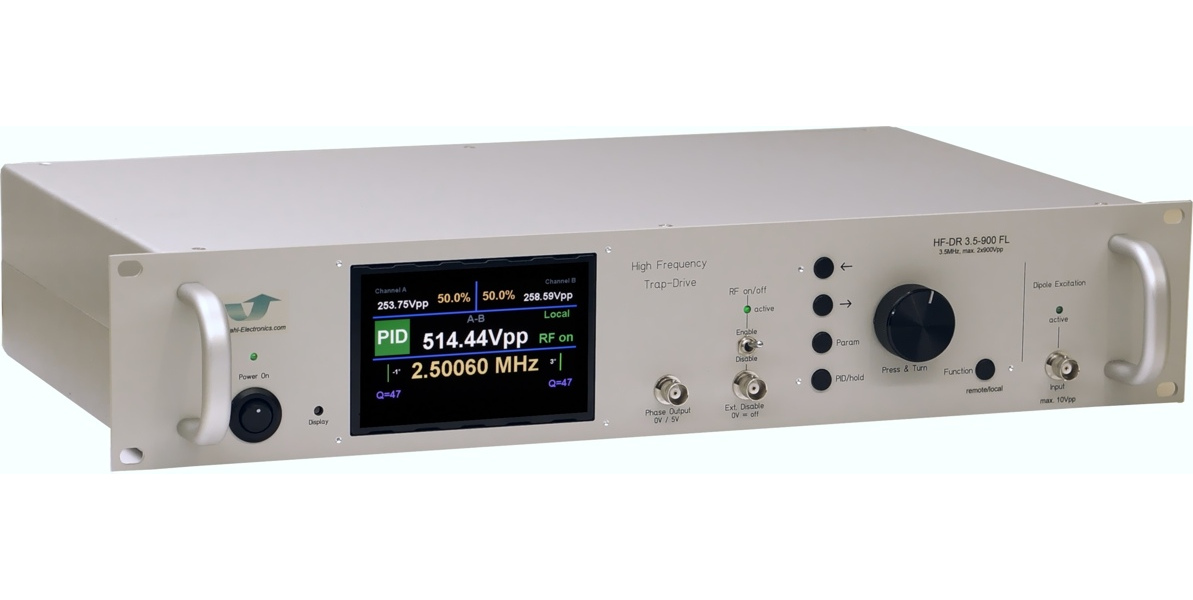
Our high frequency trapping field generators create large sinusoidal voltages with an unprecedented amplitude stability down to 3 ppm per minute.
Typically, such a state-of-the-art specification would only be achieved through complex in-house development by well-equipped research facilities. RF drives by Stahl-Electronics have evolved and proven up to the task in many demanding research projects with top research institutes worldwide.
Paul quadropole ion traps (e.g. Yb+, Ca+, Be+) and radio frequency quadrupoles (RFQ) benefit from both, the outstanding performance and the ease-of-use of our solution. Typical applications comprise general ion trapping experiments, quantum computing, and mass filters. For some models, a fast-turn-off option for swift ion ejection is available (’kill-switch’).
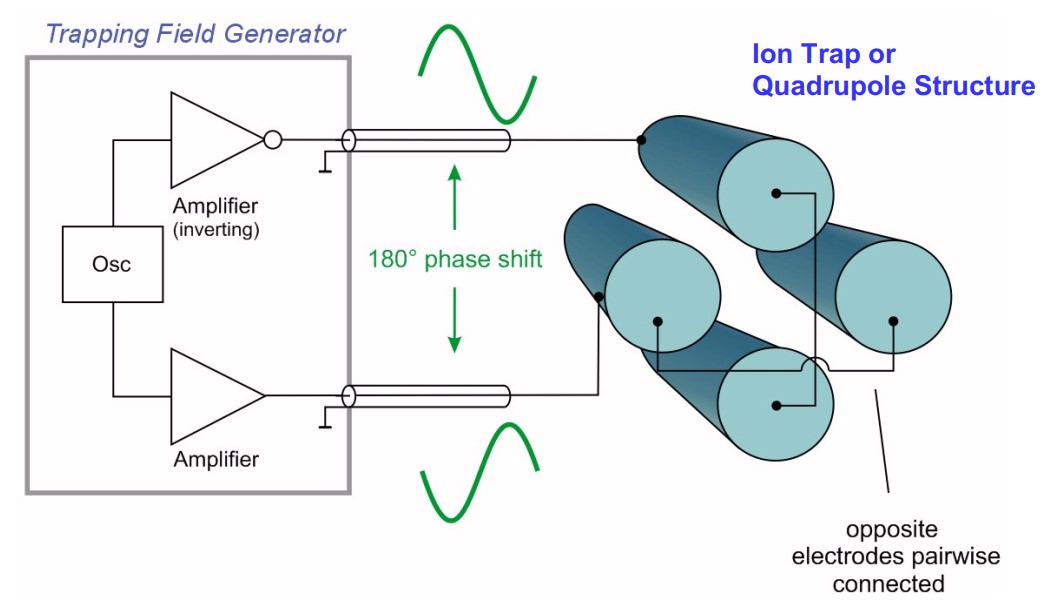
Unlike with common power RF generators, here, the outputs are capable to drive purely capacitive loads, like electrodes of ion traps or quadrupole structures.
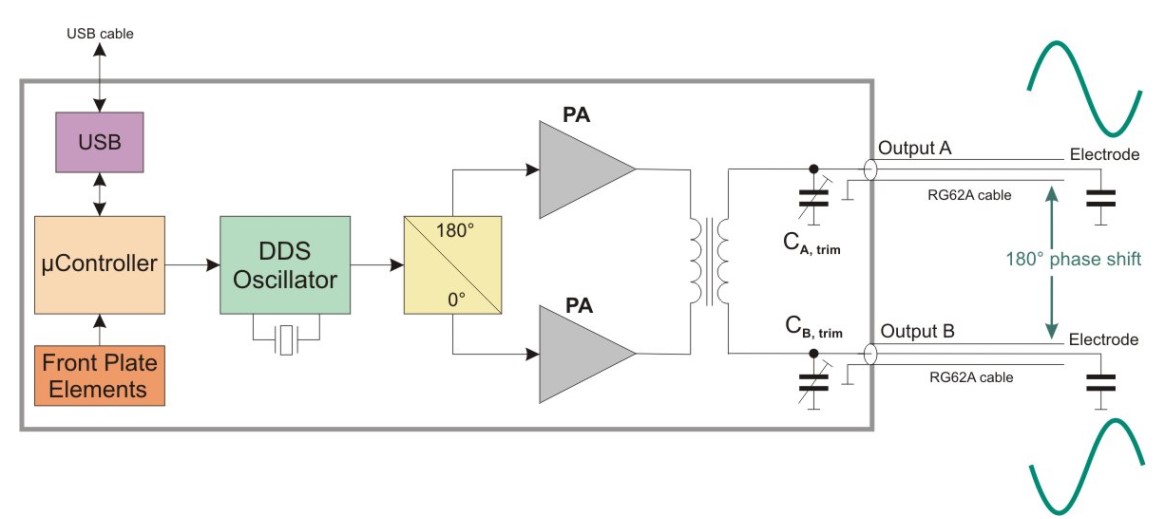
The base model HF-DR is internally equipped with a resonator to achieve higher voltage amplitudes at a narrower frequency band. See variant model HF-DRB for a non-resonant broadband version.
Key Features
- ultra precise amplitude, stable on 1×10⁻⁵ level, for outstanding ion coherence in ion clocks, quantum computing, etc.
- USB remote control
- Fast shut-off-option for ion ejection (<< 1 μs)
- f = 1.0 to 6.5 MHz, up to 1800 Vpp differentially (optionally up to 40 MHz)
Model HF-DRB
The variant version HF-DRB features a non-resonant broadband design with fast-turn-on/off capability in order to, for example, capture ions in flight or supply miniaturised mass spectrometers.
Key Features
- RF drive amplifier for ion traps/quadrupoles
- up to 600 Vpp into 100 pF load
- f = 10 kHz to approx. 1.5 MHz depending on customisation
- non-resonant broadband design
HF-DR in research publications
Our RF drives are named explicitly in the published setups of ion-trapping groups worldwide. A selection:
-
D. Rösch, H. Gao, A. Kilaj, S. Willitsch, “Design and characterization of a linear quadrupole ion trap for high-resolution Coulomb-crystal time-of-flight mass spectrometry”, EPJ Techniques and Instrumentation 3, 5 (2016). Linear Paul trap for 40Ca+ Coulomb crystals, driven at 3.275 MHz / 800 Vpp by an HF-DR 3.5-900 FL and switched off within a single RF cycle for ion ejection.
DOI:10.1140/epjti/s40485-016-0032-3 ➜ article (pdf) (open access, CC BY 4.0) -
K. Okada, K. Sakimoto, Y. Takada, H. A. Schuessler, “A study of the translational temperature dependence of the reaction rate constant between CH3CN and Ne+ at low temperatures”, The Journal of Chemical Physics 153, 124305 (2020). Cryogenic linear Paul trap driven at 3.47 MHz by an HF-DR 4.5-900 FL.
DOI:10.1063/5.0013807 -
A. Poindron, “Detection of a giant molecule with a trapped ion cloud”, PhD thesis, Aix-Marseille Université (2022). Trap supplied by an HF-DR 1.5A together with a BS 1-16-16 DC bias source.
HAL:tel-03777502 (open access) -
M. Salvi, N. N. Uma, H. Dinesan, A. Roy, S. S. Kumar, “A versatile 16-pole ion trap setup for investigating photophysics of biomolecular ions”, Review of Scientific Instruments 94, 093203 (2023).
DOI:10.1063/5.0160407 -
K. Okada, S. Kawasaki, K. Sakimoto, H. A. Schuessler, T. Murakami, H. Ueno, T. Takayanagi, “Investigation of the Gas-Phase N2+ + CH3CN Reaction at Low Temperatures”, The Journal of Physical Chemistry A 129, 1116–1124 (2025).
DOI:10.1021/acs.jpca.4c07284
Tips and tricks
- Improve response time and communication latency of the device
Try setting the latency timer of USB driver to 1 ms (default: 16 ms). See these instructions (pdf) .