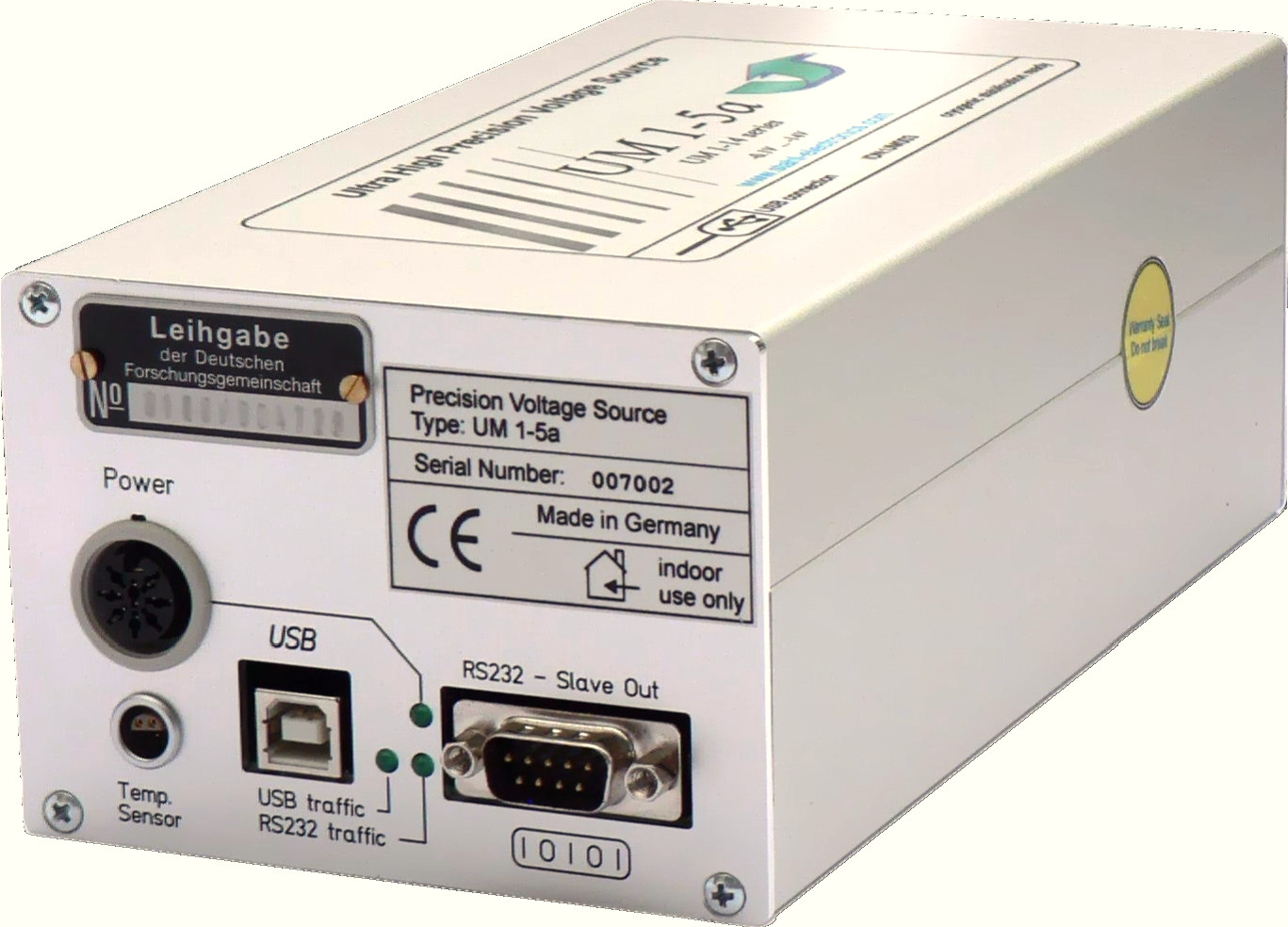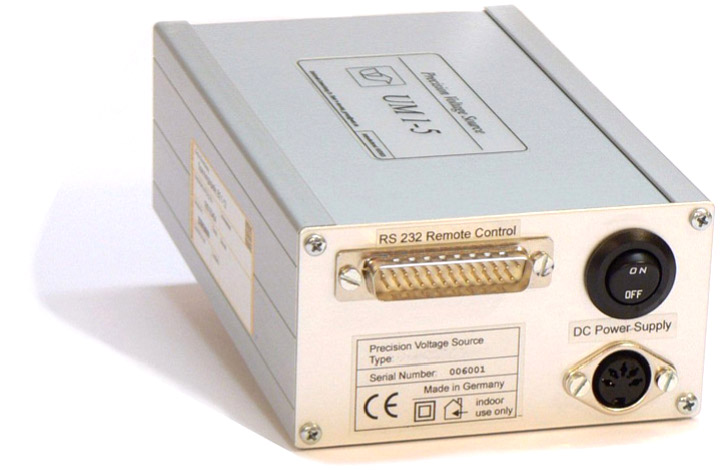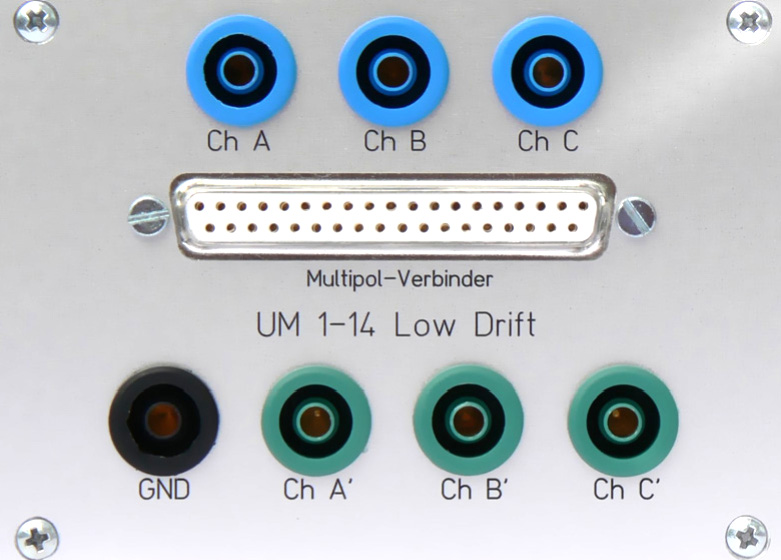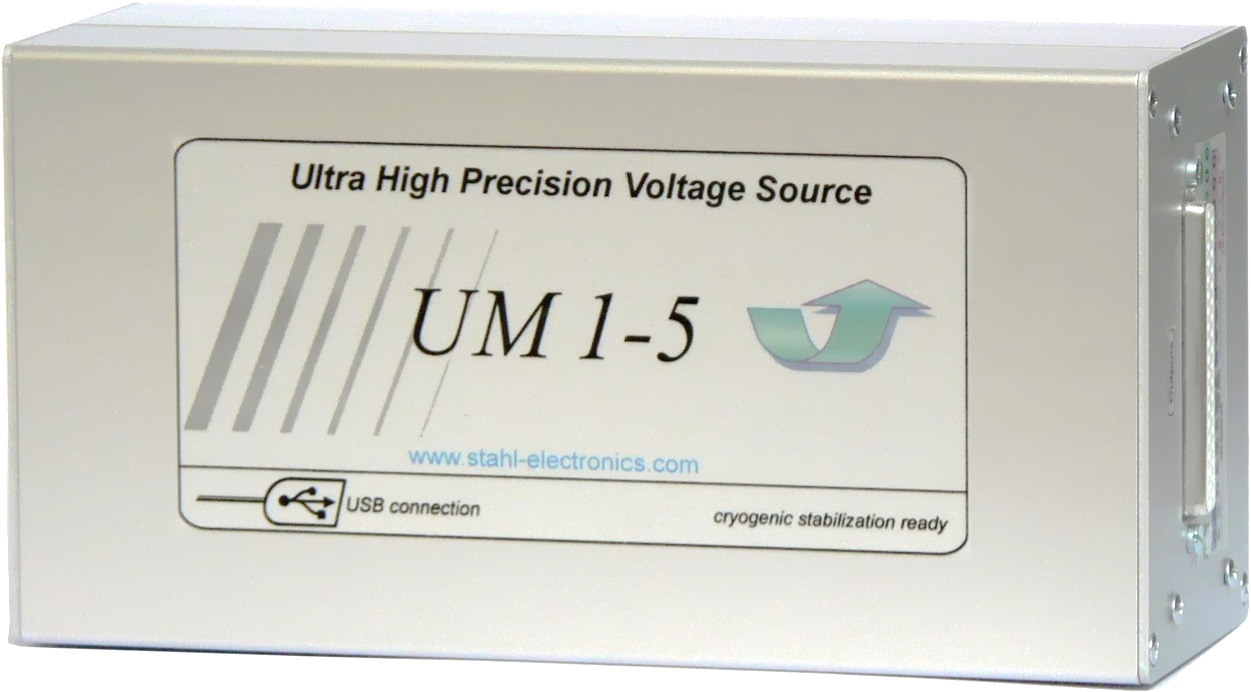
The UM is worldwide unrivalled as a 3-channel ultra high precision voltage source for its proposed voltage ranges, typically ±14 V (up to ±90 V). It features an extremely low temperature dependency of 10-6 ΔV/V per Kelvin and temporal voltage fluctuations of less than 10-7 ΔV/V per minute.
This unique combination of resolution, stability, and long term drift makes it ideal for quantum computing and high precision ion trap based spectrometry. The UM is currently used, for instance, in virtually all high precision ion trap spectroscopy experiments globally.
The voltage range of the device can be customised: According to your application, you would typically limit the maximum voltage in order to tap the full potential of the 25 bit resolution.
Key Features
- standard voltage range: ±14 V, customisable up to ±90 V.
- 3 channels each resolved with 25 bit (0.1 ppm resolution)
- 10 ppm base accuracy
- fluctuations on 10-8 level
UM in research publications
Precision Penning-trap and ion-trap experiments worldwide bias their electrodes with the UM. A selection:
-
J. A. Devlin et al., “A Penning trap single-photon counter for axion detection”, arXiv:2601.05472 (2026). Trap electrodes supplied by three stacked UM-14 sources.
arXiv:2601.05472 -
A. Kaiser et al., “Josephson voltage standards as ultra-stable low-noise voltage sources for precision Penning-trap experiments”, Applied Physics Letters 124, 224002 (2024). The UM1-14 is named as the commercial reference for small voltages up to 10 V against which a Josephson standard is benchmarked.
DOI:10.1063/5.0206779 -
B. Tu et al., “Experimental access to observing decay from extremely long-lived metastable electronic states via Penning trap spectrometry”, Physical Review Research 5, 043014 (2023). Achievable noise budget derived from the voltage stability of the UM1-14.
DOI:10.1103/PhysRevResearch.5.043014 -
C. C. Rodegheri et al., “An experiment for the direct determination of the g-factor of a single proton in a Penning trap”, New Journal of Physics 14, 063011 (2012). Trap electrodes biased by an UM1-14 at room temperature.
DOI:10.1088/1367-2630/14/6/063011 -
S. Sturm et al., “g Factor of Hydrogenlike 28Si13+”, Physical Review Letters 107, 023002 (2011). Early use of the UM1-14 in a g-factor measurement.
DOI:10.1103/PhysRevLett.107.023002